TASC

Press & Media Resources

TASC (Tulsa Advanced Sciences Camp) is a free, all-expenses-paid summer STEM program for Native American high school students, run by MIT students and staff and hosted at the University of Tulsa.

Last updated: September 13, 2026

Everything below is cleared for use. Full-kit zip download: TBD.

TASC is a program of the MIT Priscilla King Gray Center for Social Impact, hosted at the University of Tulsa. See our partners →

The short answer

Editor's box

What
A free residential STEM camp. Each student goes deep on a single science track and spends afternoons and evenings in workshops on reasoning, argument, and goal-setting. No grades, no tests, no credit — by design.
Who
Rising high school sophomores, juniors, and seniors enrolled in federally recognized tribes. A fly-in program: students come from across the country and travel is covered.
Where
The University of Tulsa, Tulsa, Oklahoma.
When
July 25 to August 3, 2027. Arrival Sunday, July 25; departure Tuesday, August 3. Ten days on campus, eight days of instruction.
Cost
Free. Travel, housing, meals, and materials are covered in full. No application fee.
Organizers
Run by MIT students and staff through the MIT PKG Center for Social Impact. Founded in 2025 by Jack Carson (MIT ’28, Cherokee Nation).
Press contact
tasc-exec@mit.edu

Application deadlines

  • Applications openNovember 1, 2026
  • Early deadlineJanuary 10, 2027
  • Early decisionsFebruary 12, 2027
  • Regular deadlineMarch 14, 2027
  • Regular decisionsApril 16, 2027
  • Reply byApril 30, 2027
Download: TBD

Reference

Fact sheet

Program name
Tulsa Advanced Sciences Camp (TASC). First reference: “the Tulsa Advanced Sciences Camp (TASC).” Thereafter: “TASC.”
Founded
2025. The pilot served 12 students; 2026 served 25; 2027 is planned for 30.
Run by
The MIT Priscilla King Gray (PKG) Center for Social Impact, MIT’s public service center, founded in 1988. TASC sits within Code.Tulsa: Igniting Tech Futures, a broader PKG initiative that also places MIT undergraduates in summer internships with the Cherokee Nation, the Muscogee Nation, and Tulsa nonprofits including Black Tech Street.
Hosted by
The University of Tulsa. Students live in TU residence halls and use TU classrooms, labs, and athletic facilities.
Founder and director
Jack Carson, MIT ’28, a Cherokee Nation citizen from Tulsa, who founded the program in 2025.
Eligibility
Rising sophomores, juniors, and seniors enrolled in a federally recognized tribe, with a GPA above 3.0. Exceptional rising freshmen may apply. Students who have already graduated are not eligible. No prior coding, lab, or advanced math experience is required or expected.
Nomination
Most applicants are nominated by a teacher, counselor, tribal education office, or community leader, but nomination is not required and direct applications are read identically.
Cost to students
Zero. Flights, ground travel or mileage reimbursement, housing, all meals, and materials are covered. No application fee.
Academic structure
Four tracks, taught in groups of roughly five students to one instructor: Chemistry and Energy, DNA Technology, AI Engineering, and Fundamentals of Reality (physics). Students choose their track at the opening ceremony on the first evening, after meeting the instructors. Two tracks run genuine lab work. Track instruction fills the mornings and early afternoons; afternoons and evenings go to full-group workshops on epistemology, calibration and probabilistic reasoning, rhetoric, ethics, and structured goal-setting, plus guest lectures and college and career sessions.
No grades, no credit
There are no tests and nothing goes on a transcript. This is deliberate — it is what allows the week to be exploratory.
Instructors
MIT and Harvard undergraduates with research experience in their subjects, supported by teaching assistants who are former TASC students. All three TAs in 2026 had been campers the year before.
2026 guest speakers
Principal Chief Chuck Hoskin Jr. of the Cherokee Nation; U.S. Rep. Kevin Hern; legal scholar Stacy Leeds; Amanda Swope, City of Tulsa; Levi Patrick, Tulsa Regional STEM Alliance; Ken Levit, George Kaiser Family Foundation; and admissions officers from MIT and NYU.Titles not yet re-verified. Confirm each before print.
Funders
The George Kaiser Family Foundation and the Patrick J. McGovern Foundation.
Website
tasc.mit.edu
Download: TBD

From TASC '26

By the numbers

TASC ’26 (July 26 to August 1, 2026)

  • 25students in the cohort, ages 15 to 18
  • 5states represented among enrolled students
  • 10+tribal nations represented among enrolled students
  • 35tribal nations represented in the applicant pool
  • 15states represented in the applicant pool
  • 4science tracks
  • $0cost to students, including airfare

Program to date

  • 12students in the 2025 pilot; 30 planned for 2027
  • 70%+of 2025 participants came from rural and highly underserved communities

Under 15% of high schools serving the Cherokee Nation reservation offer BC-level calculus or AP-level computer science.

Download: TBD

Ready to run

The story

Ready-to-run news article, roughly 600 words. Written in straight news style so an editor can run it largely as-is or lift paragraphs. Quote slots are marked and need to be filled with approved, attributed quotes before publication.

MIT-run science camp for Native high school students opens applications

Applications for the 2027 Tulsa Advanced Sciences Camp open Nov. 1, offering Native American high school students a week of graduate-level science instruction at the University of Tulsa at no cost.

The program, known as TASC, covers everything: airfare or mileage, housing in a university residence hall, all meals, lab materials and activities. There is no application fee. Students fly in from across the country — the 2026 cohort included students from Tulsa and from Fairbanks, Alaska.

TASC is a program of the Priscilla King Gray Center for Social Impact, MIT’s public service center, and is taught by MIT and Harvard undergraduates. It was founded in 2025 by Jack Carson, an MIT undergraduate and Cherokee Nation citizen. Allie Zong, a Harvard undergraduate and researcher at the Broad Institute of MIT and Harvard, serves as associate director.

The program was built around a gap in access rather than a gap in ability. Fewer than 15 percent of high schools serving the Cherokee Nation reservation offer BC-level calculus or AP-level computer science, and most reservations are further behind.

[QUOTE — Carson or Zong, on the access gap and why the program exists. 2-3 sentences.]

Students choose one of four tracks on the first evening, after meeting the instructors, and stay with it for the duration: Chemistry and Energy, DNA Technology, AI Engineering, or Fundamentals of Reality. Groups run about five students to one instructor, and two of the tracks do bench work in the university’s science building, where students run the techniques used to read and edit a genome. No prior coding, lab or advanced math experience is required.

There are no tests, no grades and no credit. Organizers say that is deliberate — nothing goes on a transcript, which is what allows the week to be exploratory.

Afternoons and evenings turn to workshops on reasoning and decision-making: estimating quantities under uncertainty, recognizing rhetorical manipulation, examining inherited values, and breaking down personal goals to find what a student is actually after. Guest speakers at the 2026 program included Principal Chief Chuck Hoskin Jr. of the Cherokee Nation, U.S. Rep. Kevin Hern, legal scholar Stacy Leeds, and admissions officers from MIT and New York University.

The application asks for basic information and at least two essays of up to 500 words, chosen from four prompts. One of the four asks applicants to make the most persuasive argument they can that TASC is not an effective use of MIT’s funding. Organizers say students have been admitted on that answer.

[QUOTE — Carson, on the adversarial prompt and what it selects for. 1-2 sentences.]

Applicants must be rising sophomores, juniors or seniors enrolled in a federally recognized tribe with a grade point average above 3.0; exceptional rising freshmen may also apply. Students may be nominated by teachers, counselors, tribal education offices or community leaders, but nomination is not required and direct applications are read the same way. Applicants may use AI tools on their essays and are asked to disclose how they did.

Rather than advertise, the program recruits through tribal education officials, superintendents and school counselors, who circulate it through their own networks. More than 70 percent of the 2025 pilot cohort came from rural and highly underserved communities.

Former students return as staff. All three teaching assistants at the 2026 program had attended as students the year before, and two members of the 2026 cohort will return as teaching assistants in 2027.

[QUOTE — alum or returning TA, on the experience. 2-3 sentences.]

TASC is supported by the George Kaiser Family Foundation and the Patrick J. McGovern Foundation and hosted by the University of Tulsa. The 2027 program runs July 25 to Aug. 3. Applications open Nov. 1, 2026 at tasc.mit.edu.
To fill the quote slots, request approved, attributed quotes from Jack Carson, Allie Zong, or a program alum through tasc-exec@mit.edu.

Download: TBD

For wire-length items

Short version

Two to three sentences, for calendar listings and wire items.

TASC (Tulsa Advanced Sciences Camp) is a free, all-expenses-paid summer STEM program for Native American high school students, run by MIT students through the Institute’s PKG Center for Social Impact and hosted at the University of Tulsa. Students go deep on a single science track — DNA Technology, AI Engineering, Chemistry and Energy, or Fundamentals of Reality — alongside workshops on reasoning, argument, and goal-setting. The 2027 program runs July 25 to August 3, 2027; applications open November 1, 2026 at tasc.mit.edu.

Download: TBD

Standard paragraph

Boilerplate

Standard program description. Approved to run unchanged at the end of any story.

The Tulsa Advanced Sciences Camp (TASC) is a free summer STEM program for high school students enrolled in federally recognized tribes, founded in 2025 by MIT undergraduate and Cherokee Nation citizen Jack Carson. A program of the MIT Priscilla King Gray Center for Social Impact and hosted at the University of Tulsa, TASC pairs graduate-level instruction in a single science discipline with workshops on epistemology, quantitative reasoning, and rigorous goal-setting. Travel, housing, meals, and materials are covered in full; students pay nothing. TASC is supported by the George Kaiser Family Foundation and the Patrick J. McGovern Foundation. More at tasc.mit.edu.

Download: TBD

One-sentence version

TASC is a free summer STEM program for Native American high school students, run by MIT’s PKG Center for Social Impact and hosted at the University of Tulsa.

Download: TBD

Two so far, more coming

Photos

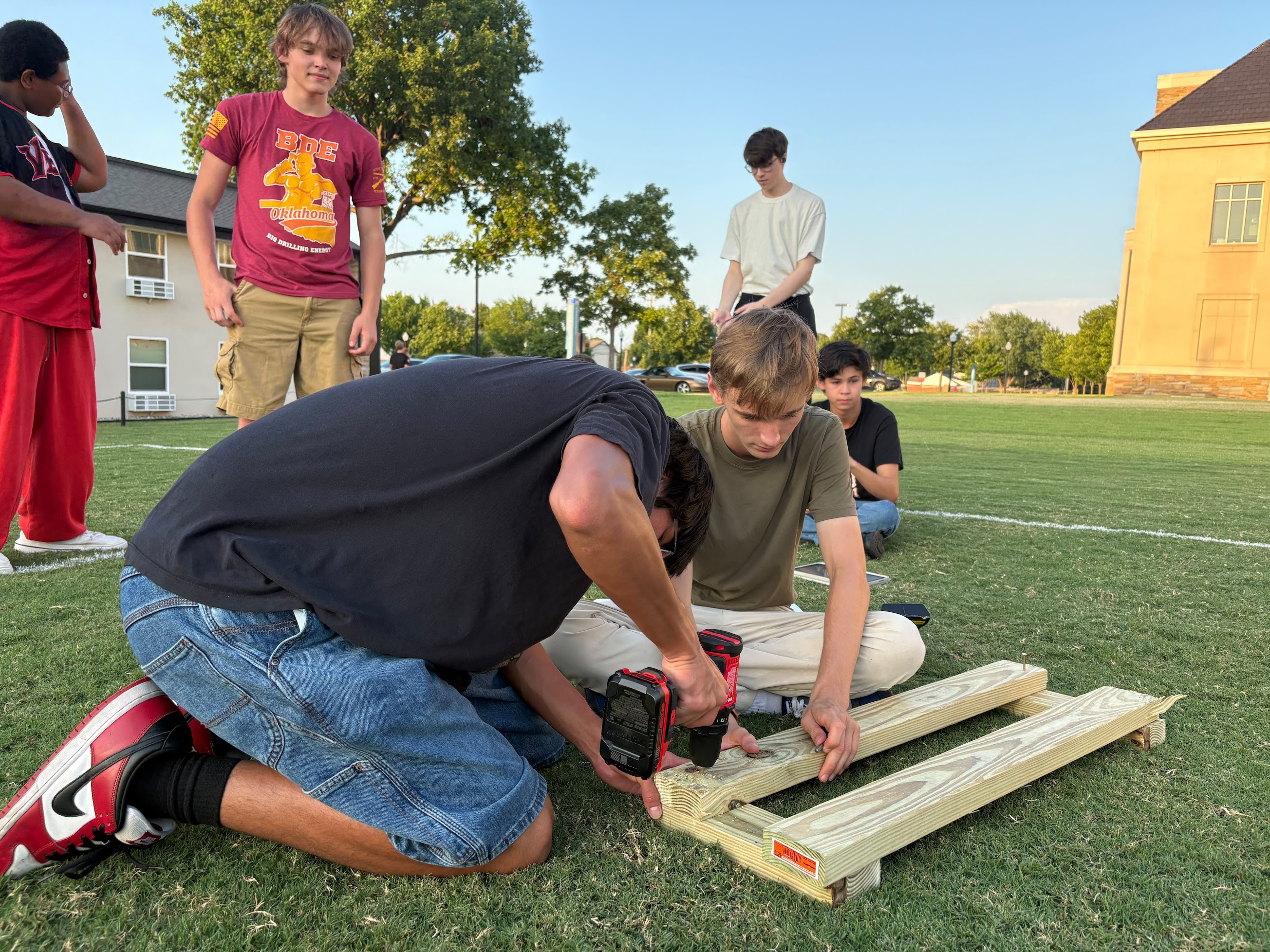
Four TASC students kneeling on a campus lawn at golden hour, drilling together the wooden frame of a trebuchet while two others watch.
Students building a trebuchet on the University of Tulsa lawn during TASC '26.
Download full-resolution JPG

TASC2026_Photo01_TrebuchetBuild.jpg

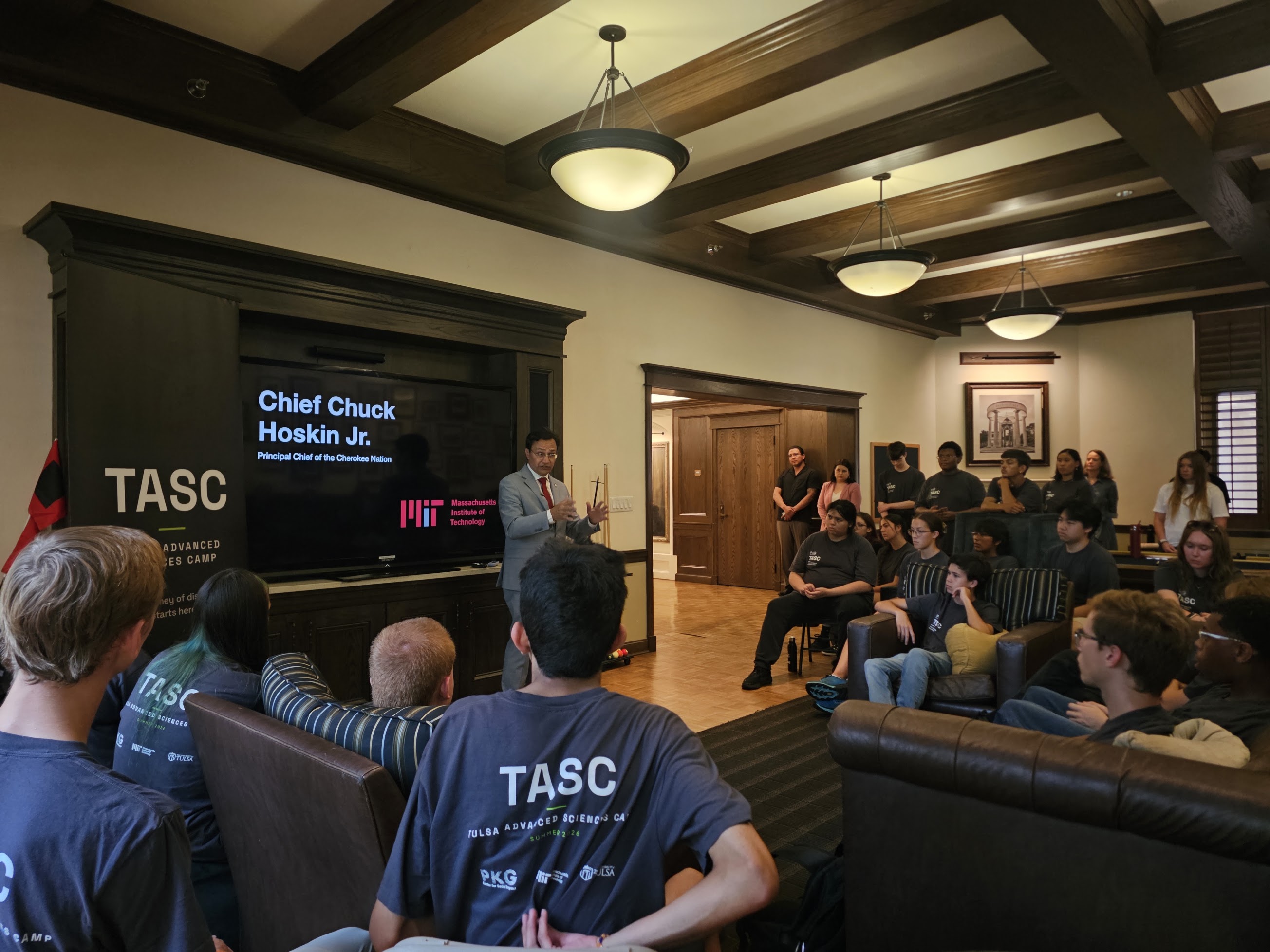
Principal Chief Chuck Hoskin Jr. of the Cherokee Nation speaking to TASC students seated on sofas in a wood-panelled room at the University of Tulsa.
Principal Chief Chuck Hoskin Jr. of the Cherokee Nation speaking to the TASC '26 cohort.
Download full-resolution JPG

TASC2026_Photo02_ChiefHoskinSpeaking.jpg

Please credit: MIT TASC. Photo releases are on file for the ’26 cohort. Additional program photos are coming.

Wordmark

Logos

TASC wordmark files are coming. MIT and University of Tulsa marks are not included; both are governed by their own brand licensing.

Download: TBD

Print-ready

Print ads

Print-ready ad files (quarter page and others, CMYK PDF) are coming. Each will carry the current application deadline.

Download: TBD

Talk to a human

Media contact

All press inquiries: tasc-exec@mit.edu — monitored daily, fastest route to a response.

Alyssa Theofanidis, PR Director

alyssa@tascmit.org

TASC ’25 alum, Cherokee Nation citizen. Available to speak to the student experience.

Jack Carson, Founder & Director

jdcarson@mit.edu · (571) 395-2420

Interview requests involving student participants are arranged through tasc-exec@mit.edu. Many alumni are minors; written parental consent is required before any interview.

TASC is a program of the MIT Priscilla King Gray Center for Social Impact, hosted at the University of Tulsa.

See our partners →